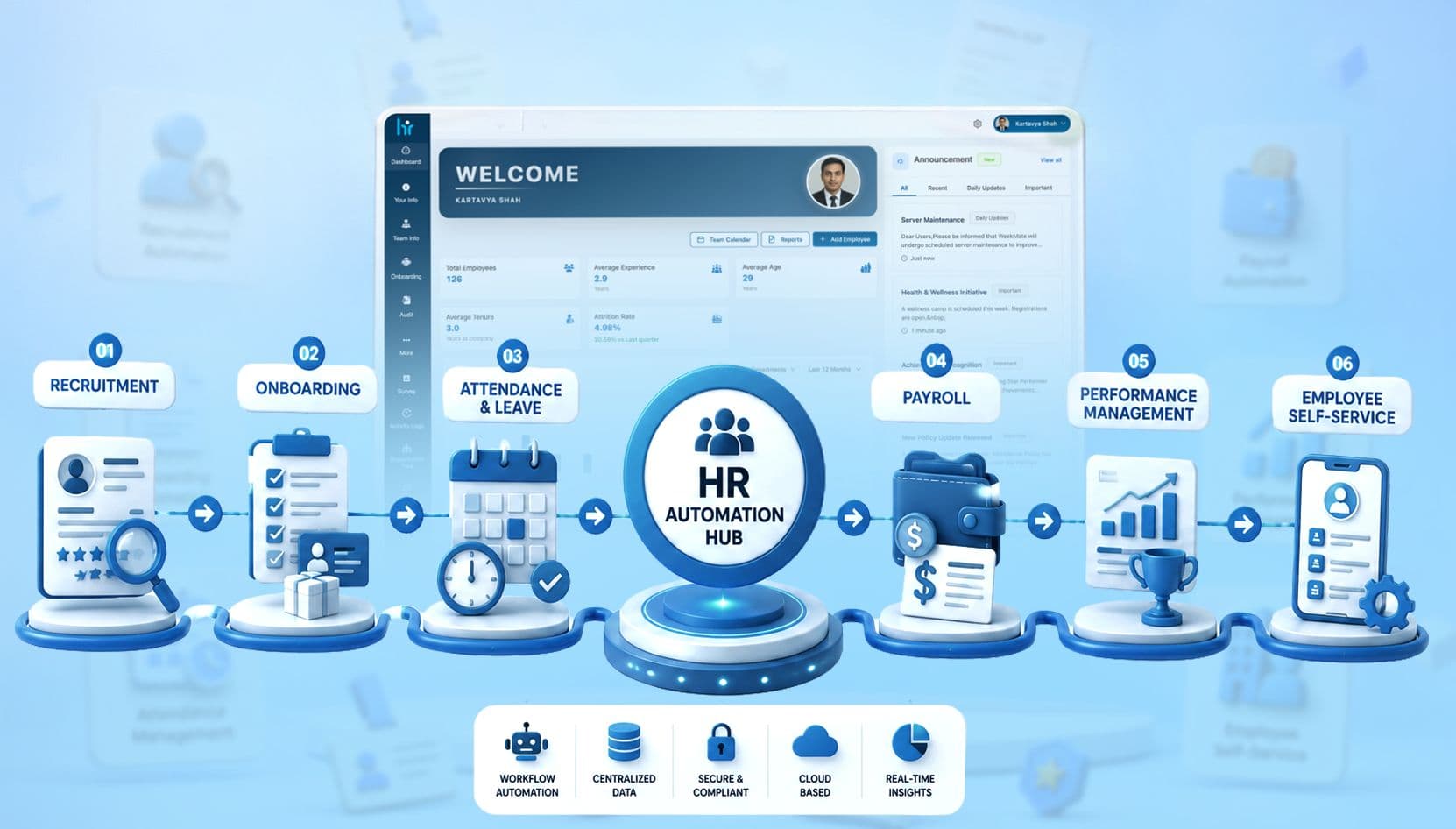
What is HR Automation?
HR automation is the process of using technology to handle repetitive, rule-based HR tasks without constant human intervention.
Instead of manually sending onboarding emails → the system triggers them.
Instead of calculating payroll in spreadsheets → the system processes it automatically.
Instead of chasing approvals → workflows move things forward.
Basically, HR automation is about:
- Reducing manual effort
- Improving accuracy
- Speeding up HR workflows
- Giving HR teams time to focus on strategy (not admin work)
It’s not about replacing HR teams. It’s about freeing them up.
Why is HR Automation Important in 2026
Things have changed. Quite a bit. Employee expectations are higher. Compliance requirements have become stricter. And businesses are scaling faster than ever.
Here’s what’s driving HR automation in 2026:
- Remote & hybrid work environments
- Real-time employee data expectations
- Increasing compliance complexity
- Need for faster hiring cycles
- Pressure to improve employee experience
Also, AI is no longer “new.” It’s embedded.
So the question isn’t “Should you automate HR?” It’s more like, “How much are you already behind if you haven’t?”
Key Benefits of HR Automation Workflows
Before we get into the details, let’s look at the benefits that HR automation offers. Let’s break this down practically.
1. Reduced Manual Work
Repetitive tasks get automated. Like data entry, approvals, documentation and others. That means fewer errors and fewer late nights fixing them.
2. Faster Employee Onboarding
New hires don’t wait for emails anymore. Everything – documents, training, system access – can be triggered instantly.